


THE CHOREOGRAPHY OF NUMBERS:
HOW RUNNING AN ORGANIZATION IS LIKE MAKING DANCE
OCTOBER 23, 2026 | WRITTEN BY CHRISTY BOLINGBROKE
There are two Dad-isms that I learned growing up and still apply in my approach with artists and our work at NCCAkron.
#1 - Show your work.
#2 - You only need a plan, from which to deviate.
As a young student, I would go to my father for help with my homework. The first thing we would need was a separate piece of scratch paper to work out and tackle the problems assigned. Maybe that’s how I became a visual learner. Between my dance training and Dad’s scratch paper, it’s no wonder that I grew up to lean into and lead a process-based organization.

If choreography is a practice of relationship — organizing bodies, people, space, time, attention, and resources to create meaning that could not exist in isolation — so is managing a nonprofit organization and building the budget at its core.
At this landmark moment for the National Center for Choreography-Akron (NCCAkron), ten years on from start-up to a fully operational, nonprofit organization, I’m going to use this opportunity to show some of the work behind the scenes and share what I’ve coined “the choreography of numbers.”
More than a financial document. A budget is the organization and understanding the relationships between people, space, time, attention requiring all different kinds of resources. A choreographic approach to budgeting can reveal your values and priorities, how power and responsibility are shared, and what artistic as well as administrative risks you are willing to take.
The numbers and examples in this essay are one manifestation of choreography behind the scenes at NCCAkron.
Choreography is also a conversation between tradition and invention. As far as the choreographic conversation between tradition and invention in budgetmaking, it is the same as when businesses and organizations look at prior years to establish a baseline or anticipate where the numbers may continue to trend.
My favorite definition, choreography, is an embodied way of thinking and processing.The choreography of numbers takes the functional task of budgeting into a more embodied and tactical rehearsal of possibilities. With a piece of scratch paper or a spreadsheet, one can sketch out and try on the numbers in a variety of ways.
IN THE BEGINNING…

2017 NCCAkron Open House After-Dinner photo with artists.
My first full day on the job with NCCAkron was November 1, 2016. There was a presidential election that same week. For many of us, it felt like up was down and down was up. NCCAkron was a totally new organization, only the second of its kind in the country. Based at a university but a separate entity, not part of the university itself, I was NCCAkron’s first and only employee for the first five years. I use the term start-up to describe those early years because that’s what we were — small, just starting out, and building everything from scratch. An early feasibility study led by DANCECleveland and Pamela Young had provided a solid foundation, key partnerships, and a blueprint for the organization’s future, but after the 2016 presidential election the future seemed less certain than ever.
While the Center had a healthy early investment in the organization thanks to Knight Foundation, I worked with the board and Phil Rosenbloom of TARN Consulting (Poughkeepsie, NY) to rehearse three different five-year budget models.
ORIGINAL NCCAKRON OPERATING INCOME MODELING AS OF 12/2016

ROSY
Everything goes as originally planned and anticipated in the feasibility study that led to establishing the Center.
STARK
With this new political climate, potential funders and partners could be more risk-adverse and reticent to invest or collaborate until they were feeling more certain. It might take a bit more time than originally anticipated to secure additional funds.
WORST CASE
No one else gives us money ever again but I still had a mandate to demonstrate proof of concept and make NCCAkron a reality for the dance field.
From 2016-2020, it was some combination of the Rosy and the Stark. I actually had a funder comment that NCCAkron was underspending by 18% compared to what they had expected. That wasn’t a scarcity approach on my part, but careful choices about how to invest modestly across many different artists, disrupting the existing lottery system of support rather than perpetuating field habits that treat dancemaking as a zero sum game.
INDIVIDUAL ARTIST BUDGETS & CHOREOGRAPHIC THINKING
In 2020, the Mellon Foundation joined NCCAkron in establishing a Creative Administrative Research (CAR) think tank. Based on the premise that there is no one way of making dances, so there is more than one way of doing the business of dance, the crux of CAR work started by building out Artist Teams with curated Thought Partners to embark on Investigative Retreats with NCCAkron. One of the original intake practices was to request a recent operating budget from a new CAR artist. There were ten Artist Teams in the first two cohorts. I have never seen so many different approaches to budgeting. And no one version was right or wrong.
Some of these artist budgets were rooted in the ideal — the dream — hundreds of thousands of dollars even though they had never realized a project larger than $30,000. Others were much more risk-adverse: because we were all in the height of the COVID pandemic (before the first vaccine), the artist shared a budget that was almost two years old. That was the last time they felt sure and grounded in the financial numbers. Still, other budgets were beyond time and space. The artist knew their creative work needed a three-year gestation period, but they did not define what the cash flow was by individual year nor when the gestation period began.

Christy Bolingbroke with Dominic Moore-Dunson and Antuan Byers.
Processing those budgets told me not everyone is starting from the same place or vantage point. I’m not talking about issues of wealth inequity. (Although that’s certainly true too.) I mean operational presumptions from mimicking what they have seen other artists do, self-awareness about how they actually want to work from an intentional place, and finding agency in the budgetary decisions and circumstances beyond their control.
Like when you approach making a dance, do you first put forth the vision and the challenge of the steps, and then hope/know your dancers will work to rise to the occasion? That would be the equivalent of setting a dream budget and hoping/fundraising until you hit your goal. But like the creative process, fundraising is not a linear path. How will you deviate or adapt from the plan when grants are not awarded and other things beyond your control happen?
Or when making a dance, do you choreograph to the strengths of the dancers you have in the room? Artistically, this would be when a sequence of steps plays to the body’s right or left side because the performers carry a dominant strength or proclivity for one side or the other. Administratively, you may also have some predominant strengths or resources but in that case, are you limiting yourself to how far your ideas can go?
Having little organizational precedent when doing the budget scenario modeling in 2016, NCCAkron’s approach at that time was to focus on operating income predictions. In the first few years, reality was a combination of Rosy and Stark models and the Center iterated accordingly.
Looking at 2016-2020 overall, all of the original operating income predictions were modest, NCCAkron surpassed them. (See below, the original Rosy, Stark, and Worst Case alongside Operating Income Actuals (green) and Operating Expense Actuals (purple).)
While our original budget rehearsals had not anticipated a global pandemic, by 2020, artist and funder relationships were primed and NCCAkron would have continued to evolve whether or not the COVID-19 pandemic happened. From 2020-2022, NCCAkron adapted and evolved to add a second and then a third payroll employee. NCCAkron went from hosting 15 artistic activities each year to 50 because of the virtual opportunities transcending physical time and space, doing some activities online or asynchronously as well as some in-person.
While not equally distributed, NCCAkron averaged 30% growth in budget size year over year in its first decade. I know that is not a sustainable nor reliable trend the Center can count on in perpetuity. Personally, I think this is the kind of false assumption the field and its stakeholders carry when they make a broad statement asking for a sustainable model.
Change is the one true constant. Rehearsing different scenarios makes you ready for anything like when the stage is a different size than you expected or the music cuts out unexpectedly. The same adaptations are needed for an organization when funders shift priorities, a major donor pulls away, or inflation drives costs up. But rehearsing budget scenarios is not only about adapting, it can also be about practicing possible strategies behind the dreams.
NCCAKRON EXPENSE DRIVERS

2026 Board and Staff Photo.
In 2026, NCCAkron has five payroll employees and three contractors, and works with at least 100 artists a year. The original feasibility study for NCCAkron predicted the Center might have three employees - an Executive/Artistic Director, a Production Manager, and a Development Director; and host five residencies a year.
My instinct in the beginning was that I did not want to invest in any more payroll positions until I had a better handle on how NCCAkron would come to operate and serve artists. As it was, my salary was the single largest line-item in the first two budget years. Adding personnel right away would not be a reflection of purpose and priorities. See below, how the Center found a way forward and how it showed up budgetarily.

The cast of this organizational dance includes: Personnel (payroll employees), Consultants (contract support), and Artists (all artist fees and direct costs for artistic activities). Like three people on stage, they do not always operate in unison but they are always in some kind of relationship to each other.
-
Artistic Expenses (orange) only exceeded Personnel (light blue) and Consultant (neon green) expenses after NCCAkron was two years in.
-
When NCCAkron secured $1.5M in multi-year grants in 2020, Artistic Expenses (orange) really took a solo out front. Personnel (light blue) continued to climb at a slower pace; and Consultants (orange) took a slight background role.
-
But between 2016-2020, Consultants (orange) played a much more pivotal role in providing specialist expertise and seasonal support.
NCCAKRON INCOME BREAKDOWN FROM FY16-FY25
The endowment created by Knight Foundation’s $5 million investment is managed by the Miami Foundation. And it was not fully vested until 2020. NCCAkron submits an annual report to receive an annual disbursement (approximately 5% of the previous 36 months average balance). While the terms of the Knight Akron Dance Fund do not require a match, NCCAkron has cultivated and maintained a 2-to-1 average for additional funds raised compared to the ongoing disbursements from the Knight Akron Dance Fund.
These additional funds have been primarily raised through regional and national foundations (red), state and federal government grants (marigold), aggregating resources with partnership or in-kind funds raised by community partners and curated artists (orange), individuals contributions (kelly green), and earned income (teal). As a process-based organization without typical earned revenue streams like ticket sales, earned income has been identified through consulting and other services to the field like guest curation, facilitation, speaking fees and/or panel service.
INDIVIDUAL CONTRIBUTIONS, PART 1
With any potential institutional funder, NCCAkron still has to translate or code-switch who we are to fit the questions underpinned by typical grant categories or guidelines. For those that prioritize community impact, NCCAkron answers the call as an incorporated nonprofit whose public benefit includes three concentric community circles: - professional U.S. dance artists, Northeast Ohio audiences, and the general public across the country. For those that prioritize artistic excellence, NCCAkron answers with choreographic innovation and diversity of perspective whether it be genre, geography, or age/experience.
Individual Donors are not a monolithic group, making the amount of translation needed like working across many dialects. So when approaching them, NCCAkron has continued to try on and sort through the nonprofit field’s professionalized donor archetypes like in established administrative texts such as The Seven Faces of Philanthropy by Karen Maru File and Russ Alan Prince. With our start-up/beginner mindset in this area, it feels more like NCCAkron is not a likely or immediately legible candidate for most individual donors’ attention. The more NCCAkron ideates around this question, the whole idea of individual patronage as it grew around individual choreographers and artists in the 20th century feels even less feasible now due to the generational transfer of wealth and fast-shifting priorities alongside artists and organizations needing to adapt and work differently.
While such uncertainty as the Center strives to find its relationship to philanthropy is challenging, daunting, and even scary at times, it is still affirming for me as a leader at the head of an organization seeking to build a bridge between 20th century working knowledge and a 21st century dance ecosystem.
In the first decade, less than 1% of overall NCCAkron support was raised from Individuals (see the tiny, green sliver in the pie chart above). This included NCCAkron board members. Without a people pipeline typical of most other, product-oriented, ticket-selling arts organizations (single ticket buyers -> subscribers/members -> donors), NCCAkron continues to experiment as well as cast what individual donors might look like for a process-based organization.
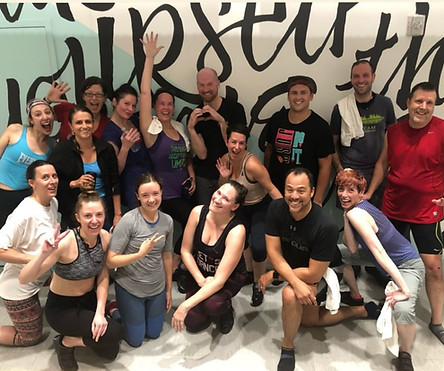
Cycling Fundraiser photo
In June 2019, in conjunction with the annual Dance/USA Conference taking place in nearby Cleveland that year, one of NCCAkron’s earliest individual giving efforts included hosting a now somewhat infamous beat-driven cycling fundraiser. The total funds raised were $670 among 19 total donors. Without a specific financial goal to be raised, NCCAkron used this opportunity to stretch our fundraising legs. The moment was based on the intersection of the dance field descending upon Northeast Ohio and being in proximity of each other. The hypothesis was that especially those of us from inside the dance field would find the opportunity to move together for a purpose appealing and become friends of NCCAkron.
Two takeaways from that individual giving experiment or rehearsal.
One, early on in the campaign, most donors didn’t want to ride but were colleagues, friends, and family who were happy to donate just to support the organization or so that others could ride at no cost. Two, among the 15 donors/riders that showed up and donated the week of the event, many have become NCCAkron co-conspirators, board members, collaborators, CAR Thought Partners, and artists in the years that followed.
BOARD GIVING & CONTRIBUTIONS
In the first decade, less than 1% of overall support was raised from Individuals. That tiny green sliver in the income pie chart is inclusive of NCCAkron board members. With NCCAkron’s founding board, starting from a place of abundance, the only ask was that NCCAkron be among board members’ top three charitable organizations when it came to their personal giving. In 2020, $100 became the recommended gift size. In 2024, the average board gift size was $278. In 2025, it grew to $350. Now in 2026, the average board gift size is $737.
This evolution did not come out of a scarcity or a “help us close the gap” mindset. But from pointing out how NCCAkron is a different size organization with different needs than where the organization started and the strong leadership among board chairs over the years.
First Pamela Young (Cleveland, OH) as founding Board Chair from 2015-2020, then John Michael Schert (Boise, ID) from 2020-2023, and most recently Eduardo Vilaro (New York, NY) from 2023-2026 - all of whom steered fellow board members into a growth mindset with their time, talent, and treasure in order to help the organization evolve.
Now, under current NCCAkron Board Chair Dacquiri Baptiste (Memphis, TN) and her leadership at the helm of the 10th anniversary committee, Board Members have also stretched themselves to make a gift in honor of this major anniversary milestone in addition to their annual board pledge.

2019 Dancing Lab: Immersive Media Through Cunningham including CB, Rashaun Mitchell, Ken Tabachnick, Silas Riener, and Pamela Young at the Akron Art Museum.

Partial Group Photo of current NCCAkron board.
This conversation started over a year prior under Eduardo’s leadership with Dacquiri as Chair-Elect. To develop the idea included shifting the organization and board member mindset to thinking of themselves as individual donors not just volunteers with board dues. And as the staff person in this scenario, I had to receive and incorporate board input and feedback into our systems to define and make room for up to a two-year timeline for pledge fulfillment.
INDIVIDUAL CONTRIBUTIONS, PART 2

Photo Booth Team Photo.
In August 2025, just three months before the 10th Anniversary kicked off, NCCAkron had eight individual donors, including our board of seven people.
In June 2026, six months into the celebration and after throwing our biggest fundraising event to date — a Dance Party Through the Decades — NCCAkron had almost 40 individual donors.
Through a special fundraising campaign over the summer to mark my own ten-year Work-A-Versary, an additional 50 new donors came through.
What NCCAkron has tried to practice and incorporate from that original fundraising event back in 2019, in each of these ongoing giving experiments during our anniversary celebration, is to design an invitation to embody our curatorial values: geographic reach, putting ideas in motion, and cultivating a movement around dance and the creative process (literally and figuratively).
What stands out to me today as an established arts administrator is what I was told as an emerging arts administrator and continues to prove true — people give to people.
This is an ongoing challenge given the way NCCAkron works. Almost all of our programs and activities center around the artist, behind the scenes, with an inward focus on process. NCCAkron has to work and think differently about how to reach people who care about the work we do and want to invest holistically in dance artists through our efforts.
That is one of the other concerted efforts behind our ongoing tenth anniversary celebration and communications plan through June 2027; and quite frankly, one of the reasons why I’ve agreed to write this work down and share it.
We need to expand our income portfolio in order to adapt, but we still resist the scarcity mindset. More typical organizations might campaign for individuals to close a gap in their fundraising. For these 18 months, NCCAkron has been experimenting with our communications and fundraising strategies to determine how many donors and friends we can make; how we can translate a process-based organization’s impact to be more legible; and how much philanthropic individuals and institutions value this work to help us identify the Center’s operating capacity for the next ten years.
BEGIN AGAIN.
In 2024, there was another presidential election that turned our world around again. This time, I worked with John Jenkins, the Board Treasurer from 2016-2026, and the Finance Committee to build out three new financial model rehearsal scenarios for the upcoming five years.
#1. Rosy: the strength of what NCCAkron established and its relationships would hold. With previous foundations, multi-year project grants renewing, government support for the arts sustaining, and ambitious growth goals in individual contributions.
#2. Stark: foundations would delay in renewing or providing new project support. Government support for the arts would be cut back, and NCCAkron would see a bump in individual donations because of our 10th anniversary but it may not sustain.
#3. Worst Case: foundations would cut project grants and not replace them. Government support would completely disappear, and NCCAkron would come up short in our $100K goal from individual donations.
Two years since then, I cannot tell you which timeline we all are living and trending in yet. Is it…
Worst Case: The calculated attack on federal support for the arts happened much faster than any of my projections.
Stark: Foundations seem to still be finding their footing, and when/if project grants for dance come back online, they are likely to look different than before.
or Rosy: At the start of the tenth anniversary I set an ambitious goal of raising $100K from individuals over two years. For an organization that had never raised more than $10K from individuals in a single year, this was ambitious. And NCCAkron met that goal in one year.
This was massive growth and progress but I also recognize sometimes folks give in honor of a special occasion, without the intention of annual giving though. Now the questions are how much of it is replicable? How much further can we go? What is the ongoing potential for individual support around a process-based organization? What else does NCCAkron have to learn in this aspect of the work?
So we keep making more friends, playing with how we can shine a light on today’s dancemakers and demystify the creative process, experimenting with fundraising strategies, and discovering what the general public and individual donors’ relationships could be to an atypical organization like ours.
The NCCAkron team and I continue to go through a lot of scratch paper.
-
Choreography is an embodied way of thinking and processing.
-
Choreography is a conversation between tradition and invention.
-
Choreography is a practice of relationship — organizing bodies, people, space, time, resources, and attention to create meaning that could not exist in isolation.
-
Choreography is an ongoing inquiry — not simply to express an answer, but to generate new questions.
The numbers in this essay are one manifestation of choreography at NCCAkron. Through this work, I aim to build our systems and structures to generate new questions alongside artists who do more than seek the same answers over and over.
Whether you are making a dance or running an organization, go find some scratch paper to try out these questions instead of simply asking how much something costs or where you are going to get the money,...
How are you organizing your budgets relative to time?
How are you organizing your budgets relative to risk?
How are you organizing your budgets relative to the non-linearity of the creative process and circumstances beyond individual control?
How often do you revisit your administrative practices and financial thinking and make adaptations?
How and when do you try new things with your choreography of numbers?
© Christy Bolingbroke, 2026